

Keep your cash in your pocket!
Understanding and Using a Bill of Exchange to Legally Settle all Bills Sent by GovCorp without spending your hard-earned cash.
What Is a Bill of Exchange?
Legal Definition: A bill of exchange is an unconditional order in writing, addressed by one person to another, signed by the person giving it, requiring the person to whom it is addressed to pay on demand, or at a fixed or determinable future time, a sum certain in money to or to the order of a specified person, or to bearer.
(See the official legal definition here: https://classic.austlii.edu.au/au/legis/cth/consol_act/boea1909148/s8.html)
A Bill of Exchange Cheque is essentially a written, legally enforceable order issued by one party (the drawer) instructing a bank or financial institution (the drawee) to pay a specified amount of money to a designated person or entity (the payee), either immediately or at a future date. It combines the characteristics of a bill of exchange—a formal, negotiable instrument used in trade—and a cheque, which is a direct order to a bank to pay on demand.
Historically, this concept isn’t new. It’s been part of commerce for centuries, designed to facilitate transactions without immediate cash exchange. All banks only operate with Bills of Exchange and Promissory Notes. The ‘money notes’ in your wallet are Bills of Exchange.
How Does a Bill of Exchange Work?
Glossary of Terms:
- Authority to Process: A document that should accompany each Bill of Exchange, available from LipForms.com.
- Bill of Exchange (BoE): A written, unconditional order issued by one party (the drawer) directing another party (the drawee) to pay a specified amount to a third party (the payee) or to the bearer, either on demand or at a fixed future date, as governed by the Bills of Exchange Act 1909 (Cth).
- Case Law: Legal precedents established by court decisions, used to interpret and apply laws like the Bills of Exchange Act 1909.
- Drawee: The party directed by the Bill of Exchange to make the payment, typically a bank or an entity owing money to the drawer.
- Drawer: The party who issues the Bill of Exchange, ordering the drawee to pay the specified amount to the payee.
- FOI Requests: Freedom of Information requests made to government agencies (e.g., Attorney-General) to access documents or confirm legal positions, such as the applicability of the Bills of Exchange Act 1909.
- GovCorp: Shorthand for government and corporate entities making financial demands (e.g., for taxes, fines, or bills).
- Legal Tender: Currency or coinage that must be accepted if offered in payment of a debt, as defined by the Currency Act 1965 (Cth) in Australia (e.g., Australian dollar notes and coins).
- Payee: The party to whom the payment is directed in a Bill of Exchange, either a specific person or the bearer of the document.
- Paper Trail: A record of documents and communications (e.g., copies of BoEs, mailing receipts) kept to provide evidence in legal or financial disputes.
DRAWER & DRAWEE DEFINITION
- A drawer is the person or entity who creates, signs, and issues a negotiable instrument—such as a cheque or bill of exchange—ordering a drawee (typically a bank) to pay a specific sum of money to a payee.
- The drawer is the account holder authorizing the funds’ transfer.
- Key Aspects of a Drawer:
- Definition: The maker of a bill of exchange or cheque.
- Role: The person who initiates the payment by writing and signing the instrument.
- Liability: The drawer is responsible for ensuring the instrument is paid; if the drawee dishonours it, the drawer is generally liable to the holder.
- Context: In a check transaction, the drawer is the account owner, the drawee is the bank, and the payee is the recipient.
Key Diffrerences
- Drawer vs. Maker: In bills of exchange/checks, it is a drawer. In promissory notes, the creator is called a maker.
- Drawer vs. Drawee: The drawer orders the payment; the drawee (bank) makes the payment.
Simplified Steps to Create a Bill of Exchange
This is very important:
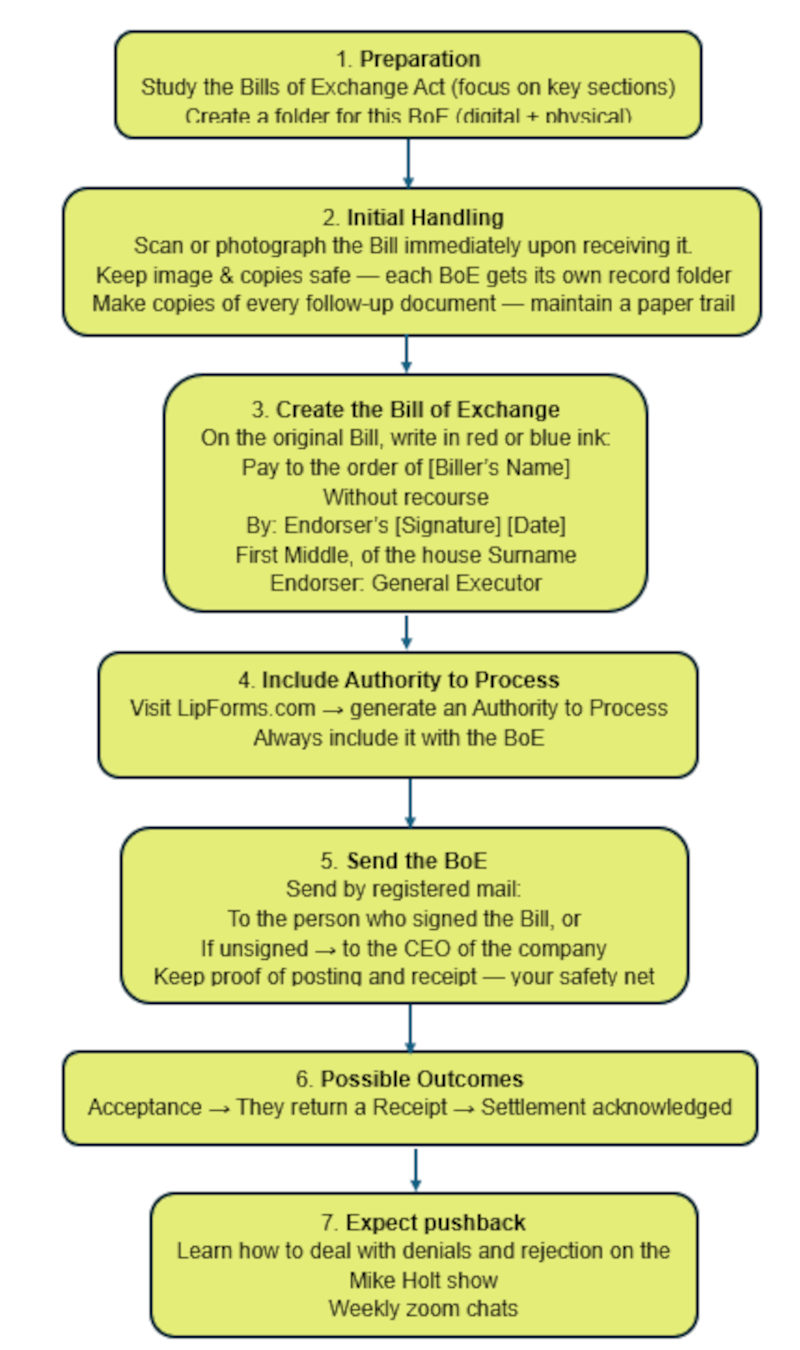
1. Scan or photograph the Bill as soon as you get it and keep the image in a folder dedicated to each Bill of Exchange
2. Always keep copies and create a paper trail
3. Proof of receipt for the BoE you send back to GovCorp is your safety net.
Join the Zoom chat every Thursday to ask questions and meet others. Click below!
 |  |  |
| Click to join the Australasian Zoom | Click to Join Mike’s Americas Zoom | Click to Join Mike’s European Zoom |
Follow these steps each time you create a Bill of Exchange:
- Before you start, study the Bills of Exchange Act and click here to familiarize yourself with the most important sections.
- Immediately make a copy of the Bill, and make copies of every follow up document. Keep them to create a paper trail.
- Create your Bill of Exchange by signing the original Bill like this in red or blue ink:
Pay to the order of [Biller’s Name]
Without recourse
By: Endorser’s [sign with your usual Signature] [Date]
First Middle, of the house Surname
Endorser, General Executor - Go to LipForms.com to create an Authority to Process and always include this document with any BoE you create.
- Always send the BoE and any accompanying documents by registered mail, addressed to the person who signed the Bill, or if there is no signature, send it to the CEO of the company.
- Sit back and wait for their response. By law, they should respond with a Receipt, but be prepared to handle any rejections.
- Acceptance or Rejection: The creditor receives the BoE and has a limited window to accept or return it: Typically 72 hours, unless the Biller states you must pay within a time limit they include on the Bill. There is no law about this. It is up to the Biller to set a time limit. If they do not, they have 72 hours to respond or the Bill is legally considered “settled” See the Bills of Exchange Act Ss 47 and 48.
- Settlement: If there is no response, or they reply saying they do not accept Bills of Exchange, the debt is settled.See the Bills of Exchange Act Ss 47 and 48.
An Example of what to write on a Bill:
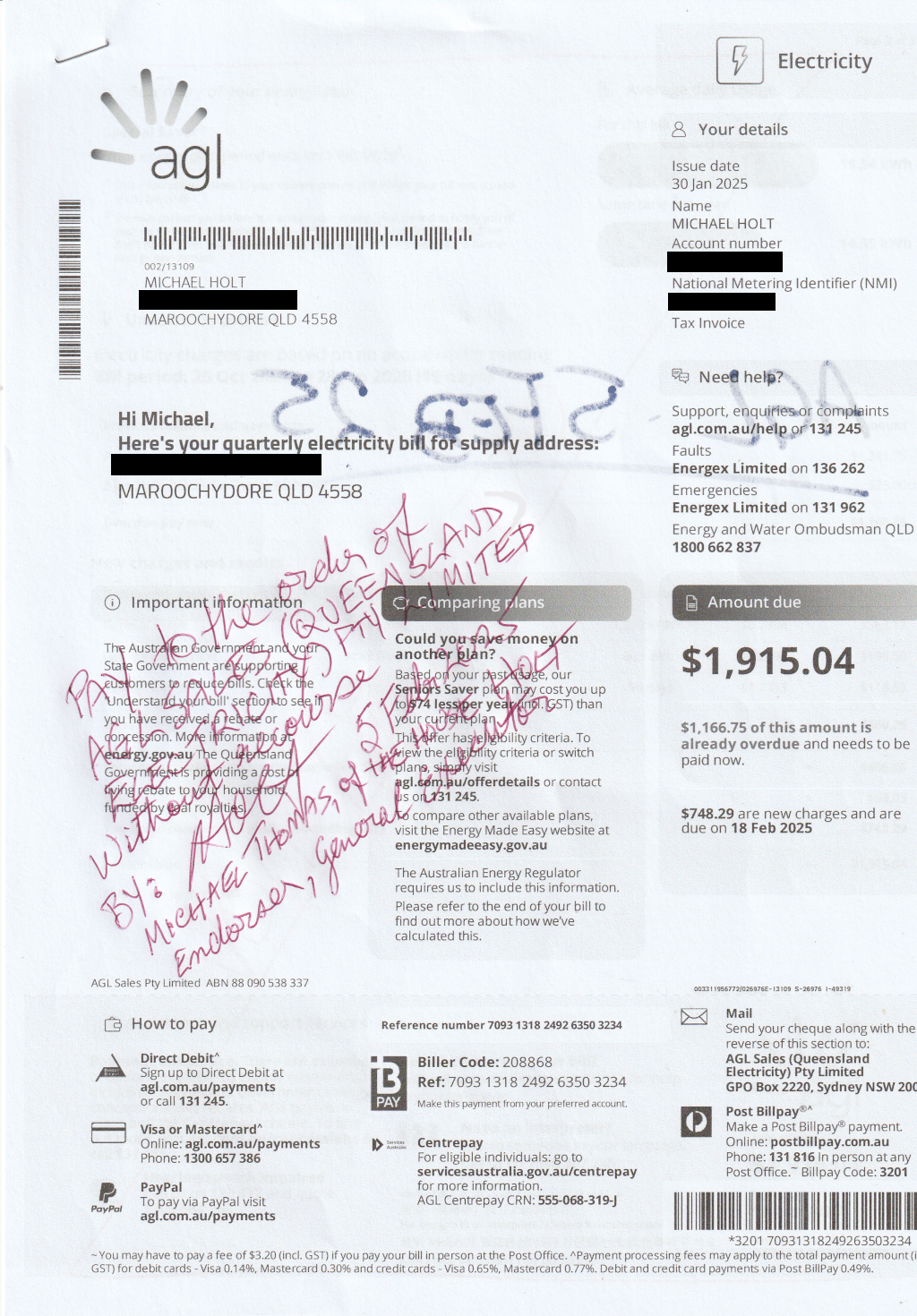 Use blue or red ink. Never black. This not only indicates a living man or woman signed, but it makes your writing clear. | 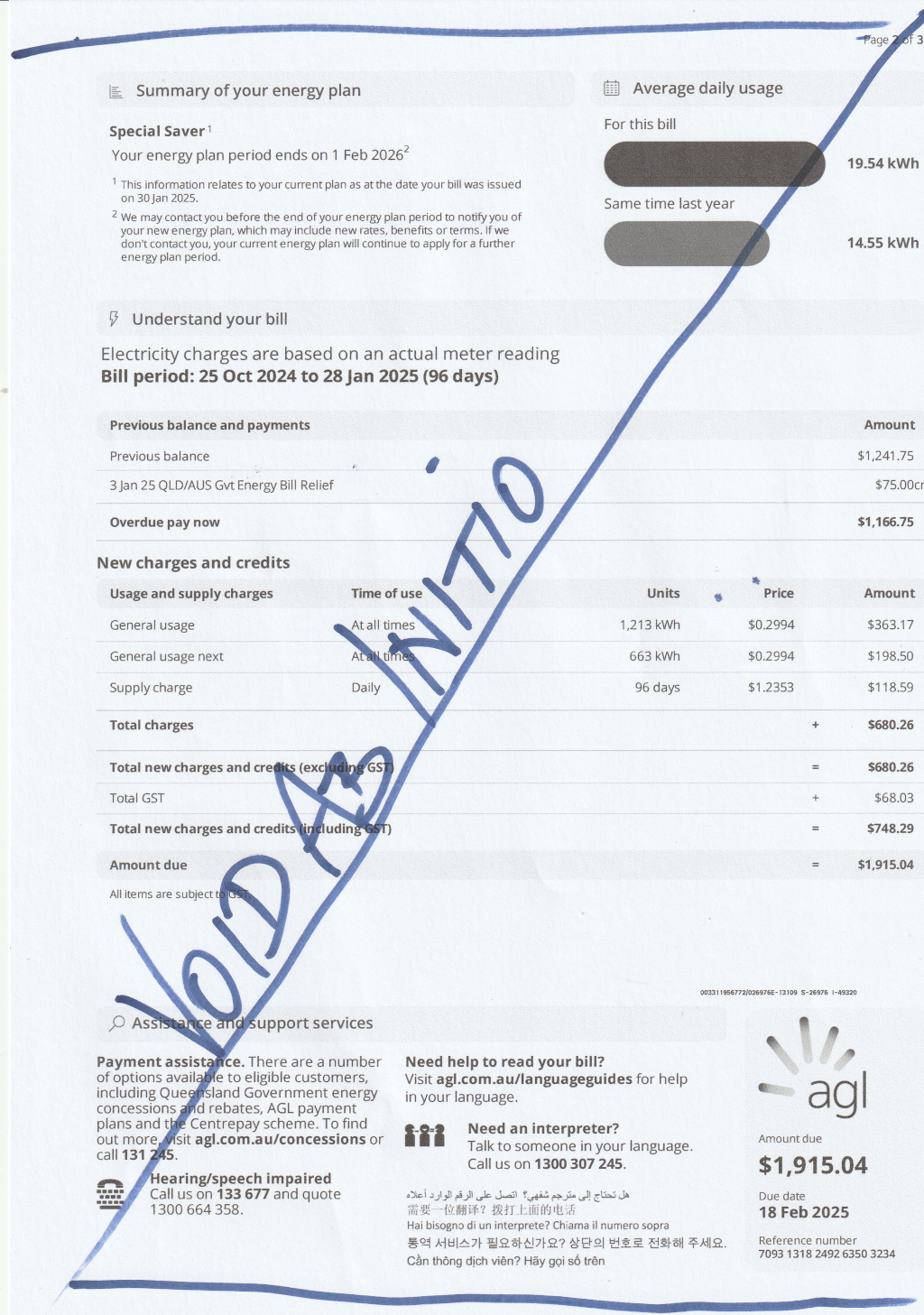 Draw a Z from top to bottom on any pages that are not part of the bill. What does it mean? Click here |
| Generate the Letters | Join Telegram (LIP) |
 Click to generate a professionally written letter using the simple form generator that mails you the letter ready to send. |  Click here to join LIP Telegram to find tons of information about BoE, and to connect with others. |
Proof it Works
Read the many stories of success on Telegram (LIP) section Winners & Grinners. The link to Telegram LIP is available above too.
Know the Law
All government agencies that issue Bills to private people, such as councils, electricity and water providers, operate under corporate rules, but like all Australians they must OBEY all our laws. GovCorp demands for you to pay their bills lack legitimacy without a court conviction, making a BoE a lawful countermeasure. We use their laws to stop their corruption and force them act as the PUBLIC SERVANTS they are.
What can go wrong:
- Agencies might ignore the BoE and escalate (e.g., license suspension or even court). Do not fear this. Use it as an opportunity to challenge their decision, and threaten to take them to court for breaking their own laws.
- Legal recognition varies – courts may not always uphold this tactic, but if you go prepared with all the documents in your paper trail you have an excellent chance of winning. A win is a precedent everyone else can use. However, it is unlikely they will want to go to court, as a loss could collapse the whole system. There have been many reports that their case was settled out of court instead.
When GovCorp Refuses to Honour your BoE
Billers often attempt to refuse to accept a BoE. But this is because they do not know the law. The key is consistency and confidence – treat it as a lawful process, not a bluff. When an organization refuses to accept a Bill of Exchange, you are probably dealing with a bureaucrat who does not know the law and only knows how to process bills as they have been taught. Therefore, they need to be educated. Use these letters to respond and remember to ask them to prove they are exempt from the Bills of Exchange Act:
First Response: If the organization refuses your BoE, stating they do not accept this form of payment, send this letter.

Download and edit any text in RED in this Word document. It explains the Bills of Exchange Act law to GovCorp officers, and asks them to prove they are exempt from the law. Make sure to include the FOI letter from the Attorney General’s Office as well.
Second Response: If they continue to refuse to process your BoE, download and send this letter:

Download and use this template letter when a company that you have already sent a Bill of Exchange to refuses to accept it, claiming they do not recognize Bills of Exchange. They are after your cash. But they have no right to it, so never give in and pay them with your cash. By denying them our cash we are weakening their illegal system. It’s up to each one of us to fight back.
Click the link below to find FOI Requests to Country Attorney Generals confirming no government agency is exempt from the Bills of Exchange Act:

Got Questions? Click here…

What to do if GovCorp decides to take you to court
Case law confirms that Bills of Exchange (BoEs) can be used to settle financial obligations when properly executed. For BoE-related case law, Bank of Australasia v Hall (1907) 4 CLR 1514 addresses BoE acceptance under the Bills of Exchange Act.
When presenting a BoE in court, be prepared with clear evidence and a thorough understanding of the laws you will cite. By presenting the facts confidently and accurately, you can demonstrate the legal basis for your claim, as courts are bound to uphold applicable laws.
Take these when you go to court:
- A copy of the FOI response from the Attorney General
- Take the Paper Trail you have created, including a copy of the BoE(s) you sent, and copies of all correspondence between you and the organization, any letters they sent you attempting to deny accepting the settlement.
- Print out and take a copy of the Bills of Exchange Act for your country. We have provided links to Bills of Exchange for many countries below. If your country is not listed here, please send us a link to it and we will add it to the growing list. An easy way to find the equivalent sections in your country’s Bills of Exchange Act is to use any AI program. We prefer X/Grok, but ChatGPT is good too. This is what you ask: compare the australian bills of exchange act 1909 with the [your country] bills of exchange act [provide the link here] and give me the list of sections in the slovenian act that compare to the australian act sections, 8, 26, 47, 48, 68. It will compare the two bills and show you the equivalent sections in your bill. Then print them out and include them in your court documents.
- When you go into court stick to the FACTS. Magistrates and judges hate wasting time. There is plenty of help on Telegram (LIP) Court Matters (Click on the Image LIP FORMS above).
- Often, the court or GovCorp solicitors will accuse you of being a “sovereign citizen”. Ignore them. You are in court to establish the FACT that you have acted within their laws. Never respond to their claims, unless it will help you present the FACTS. Instead, always challenge any claims they make in court. If they make the claim they must prove it for the court. You are not there to fight their claims.
- Common law does not work in their courts. Don’t try to use it. Their courts are purely commercial contract courts. You are there to prove that you have acted legally, not to debunk the opposition.
- If/When the opposing solicitor attempts to argue that a BoE is not a legal financial instrument don’t try to educate him. Instead, always challenge any claims they make and ask them to prove their claims, or prove their client is exempt from the law.
- Show the magistrate/judge your evidence – It’s called Presenting Evidence to the Court – and explain that you have acted honorably while doing everything possible to settle the account legally. Ask the magistrate/judge if the organization that has summoned you to court can prove they are exempt from the law. That should settle your case in your favour. However, in the corrupt court systems we currently suffer under there are no guarantees that they will follow the law, so be prepared to be defeated. But always go in with a positive attitude, because you are right and they are wrong.
KNOWLEDGE IS POWER! GET THE POWER AND BE CONFIDENT
Final Thoughts
As you gain more knowledge you become more Confident. This is essential. You must be confident you are right and they are trying to perpetrate a criminal act against you.
Using a Bill of Exchange to tackle GovCorp demands for your money is a bold move – a mix of legal savvy and defiance against perceived GovCorp overreach. It’s not about dodging responsibility but questioning the legitimacy of their demands. Whether it works depends on your execution and persistence, and the agency’s response. Never give up because “it’s too hard”.
This is very important. Read it!
If you’re intrigued, start small
Test it on a small fine first
and build up your confidence
Must Watch Videos
These videos explain how BoEs work. Watch them at least once each. They share invaluable information:
Richard Vobes explains how your birth certificate works: The Trust is in your name. Grab it!
And here is another brilliant example from Richard Vobes of how to deal with Council demands for your money.
Michael Rolf and Mike Holt discuss and explain BoEs
South African Michael Tellinger explains how Bills of Exchange work
Visit his website here. It’s fascinating. https://www.michaeltellinger.com/
Michael Tellinger and Scott Cundill discuss the fascinating story about Banks and the Global Banking Scam
– 7 March 2023
Would you like to have a handy reference? Get this e-Book in PDF format and read it any time.
References:
Here’s where to find your country’s Bills of Exchange Act. If yours is not listed, please send us the link to your country’s Bills of Exchange Act and send it to us to publish here: mike@mikeholtshow.com
- The Australian Bills of Exchange Act 1909
- Belgium Lawbook of Economics’. Article VII.216: It is in Dutch, but the Belgian legislature for the Bill of Exchange is in a lawbook called (translated) ‘the Lawbook of Economics’. Article VII.216 is all about the bill of exchange (in Dutch: “Wisselbrief”). Use ctrl+f search function to find the chapter
- Belgium Bill of Exchange Act (Dutch)
- Canada Bills of Exchange Act
- Cyprus Bills of Exchange Law
- Danish Bill of Exchange Act
- Estonia Bills of Exchange Act – Võlaõigusseadus
- France Code de Commerce
- Gibraltar Bills of Exchange Act
- India THE NEGOTIABLE INSTRUMENTS ACT, 1881 (PDF)
- Ireland Bills of Exchange Act
- Jamaica Bills of Exchange Act
- New Zealand Bills of Exchange Act
- Norwegian Bill of Exchange Act 1932
- Poland Bill of Exchange Act
- Romanian Bill of Exchange Act – Law #58/1934
- South Africa Bills of Exchange
- Spanish Bills of Exchange Act 1985
- Swedish Bill of Exchange Act
- Slovenia Bills of Exchange Act
- Tonga Bills of Exchange Act 1988 (Revised)
- UK 1882 Bills of Exchange Act
- US Bill of Exchange – NOTE: The United States does not have a single federal “Bills of Exchange Act” in the same way that some other countries do, such as the UK’s Bills of Exchange Act 1882. Instead, the law governing negotiable instruments, including bills of exchange, is primarily found in the Uniform Commercial Code (UCC) adopted by individual states. The UCC Article 3, in particular, governs negotiable instruments, including bills of exchange.
Know the most important sections of the BoE Act
- BILLS OF EXCHANGE ACT 1909 – SECT 08 – Bills of Exchange defined
- BILLS OF EXCHANGE ACT 1909 – SECT 22 – Definition and requisites of acceptance
- BILLS OF EXCHANGE ACT 1909 – SECT 24 – General and qualified acceptances
- BILLS OF EXCHANGE ACT 1909 – SECT 25 – Inchoate instruments
- BILLS OF EXCHANGE ACT 1909 – SECT 26 – Delivery
- BILLS OF EXCHANGE ACT 1909 – SECT 35 – Presumption of good value and faith
- BILLS OF EXCHANGE ACT 1909 – SECT 36 – Negotiation of bill
- BILLS OF EXCHANGE ACT 1909 – SECT 47 – Non-acceptance
- BILLS OF EXCHANGE ACT 1909 – SECT 48 – Dishonour by non-acceptance and its consequences
- BILLS OF EXCHANGE ACT 1909 – SECT 50 – Rules as to presentment for payment
- BILLS OF EXCHANGE ACT 1909 – SECT 66 – Acceptor the holder at maturity
- BILLS OF EXCHANGE ACT 1909 – SECT 68 – Cancellation
- BILLS OF EXCHANGE ACT 1909 – SECT 70 – Acceptance for honour supra protest
Key Things to Know:
- If you have a payment plan, such as a mortgage or a large Bill, and you would like to settle the whole account, ask the organization to send you a consolidated invoice so that you can settle the account in full. Tell them to include any interest and fees for settling the account early as well.
- Never answer their phone calls or emails. If you do unknowingly answer a phone call from them, when you realize who you are talking to just say, “I’m sorry. I cannot talk to you on the phone about this. You must always communicate by mail only.” And then hang up. You need to force them to create a paper trail so that they cannot deny anything, especially if your case ends up in court.
- If they email you, never respond to the contents. Simply reply with an instruction for them to communicate with you only by post office mail.
- Always scan or photograph the original bill so that you have a record. Write your BoE message on the original and send it back.
- If their Bill includes a due date, you must respond before then, or be in dishonor.
- When they refuse a BoE the account has been settled.
- If you know the name of a person sending you GovCorp demands for your money, address your BoE to them. But if not, address it to the Chief Financial Officer of the organization. The CFO is often the person with the knowledge on processing Bills of Exchange.
- A BoE is a valid financial instrument. Any organization claiming it does not accept BoEs is just saying they are ignorant of the law. Write back and ask them to PROVE they are exempt from the law. They have made the claim. Now they must prove it.
- You can generate the letters to accompany your BoE, or to respond to their denials, by filling in the details at this website and you will receive a beautifully written letter to send with your BoE and responses: https://lipforms.com/
- BoEs work in any country that follows the UNIDROIT (UCC) Code that governs how governments must deal with financial instruments to facilitate international business..
- REMEMBER! Never give up. When GovCorp makes a claim, or tries to deny that they are bound by law, you must always challenge them to prove their claims. Write and ask them to PROVE that they are exempt from the law. They can’t, of course, so this question should stop them in their tracks.




106 thoughts on “How to Create a Bill of Exchange (BoE)”
Hi Mike. Why has what you have to write on the bill/demand changed? The last time I looked we were told to write “THIS BILL/OFFER IS ACCEPTED AS MONEY…” Is that txt still valid in creating a BoE?
Graeme
Yes, I’ve simplified it into one page.
Mike, does that mean the old wording is no longer valid? I’ve just written it all over my Rego renewal before seeing your new format. Does that mean I should not send in the paperwork and now pay the rego fee?
The wording in both versions is valid. The signature is what gives the BOE its power.
I sent a BoE to Vic roads to settle my rego, 2 weeks before it was due. I never received it back, and when I checked the website my car was unregistered.
Could you please provide comment for the Karen post on May 2, 2025. How do you ensure the car is registered when paid with BoE?
I am going to do a BoE at the end of this month for my council tax. However, iI am having difficulty in finding the exact postal address for the CEO. I know his name, but can not find an address for him. The council offices in my county are spread over diffent areas of the county. The head office is due for closure next year and another head office has been built. But I can not say for certain, which office the CEO is located.
The coincil tax bill itself does have an address for postal payments. Should i send the BoE and letter to that address?
Hi Mike,
I love what you’ve done here 💪✌️
I’m wondering similar to Greame, here. Does it matter if we send it to the wrong ‘Head Office’? Ie. The CEO is likely in the ACT but the address on the bill is Melbourne.
It makes no difference. They will put it in the hands of whoever needs to deal with it.
Awesome. Thank you.
I’ve recieved their rejection letter. The 1st response letter is perfect, I’m just completing it now. But near the end it says “As my Public Servant, Name”. Who do I refer to here?
No. The Public Servant answer was obvious. Fantastic work & thank you for all this knowledge and documents.
Mike, has the wording on the BoE changed? The information I previously had was “THIS BILL/OFFER IS ACCEPTED ….”. Is that wording no longer valid? If not, do I use a copy of the original document and use the new wording?
Hi Mike .
I’ve send BOE to a water company in UK . The response was that they are unable to accept my offer and they returned original bill back to me. Should I send the BOE back to them again with 1-st letter presentment ?
Yes
Hi Mike. I am wanting to send a BOE to my water company here in the UK. I went to the lipforms.com web site and got an Authority to Process Bill of Exchange Letter generated. The generated letter refers to Australian acts such as the Bill of Exchange Act 1909 and not the UK acts. Is there a way to get the letter generated with the UK acts or do we have to change every reference to an Australian act etc manually, which would be prone to error? Rick.
Hi Mike,
Thank you so much for this extremely helpful information. My husband and I are about to send in a BoE for our council tax in the UK, but because the demand is in both our names should we write the information twice and both sign it (once from each of us)? Or can it just be done in my husband’s name as he appears first on the demand?
Many thanks in anticipation.
I also am curious about this!
Hi Mike … Havng read through several times I am unclear from the above.
Do you create the BoE using the original fine notice and SEND A COPY or
do you send the original fine notice and keep a copy?
From reading here, you send the original ensuring you have a digital and paper copy to call on with the registered mail stickers.
Yesterday I sent off my BoE for my council tax – by special delivery. As far as I can tell, I have done the BoE/Authority to process letter, correctly. I am awaiting their response.
Graeme
Excellent work; all my support to you. Your method has helped me greatly here in the U.S. clearing out completely medical bills for the $8400 amount due to an accident. I haven’t dared to try it out with utilities and other things yet, but I will. I am from DFW Texas.
That’s good news thanks Isaac. Proves that the BOE method works in any country. Don’t be afraid to do it now on all GovCorp Bills. Keep your cash in your pocket!
Good to hear. Would you be willing to share you work
Issac man help me out it seems like everything on here is from a deferent country is it all the same or what?
We refer to the various Bills of Exchange Acts that exist around the world. Learn how on my weekly zoom chats:
https://mikeholtshow.com
Did you ever try it with utility bills?
Yes, and it’s worked for over 18 months…. because it’s the LAW.
Hello Mike
Thanks for all you do, I recently paid a speeding fine using a BoE i got the usual rejection, the fine then went to the collection dep SPER, I sent the second letter which states the sections of the ACT now they are intending to cancel my license, what course of action would you suggest, do I take them to court?
Wait to see what action they take. If they do take your licence, file in your local court to have it reinstated, because they have denied your settlement. Make sure you take all the paperwork between you and them to prove your case, and take a copy of the Bills of Exchange Act 1909 so that you can show the magistrate or judge that they are claiming to be exempt from the law. When you start presenting your case in court you ask the SPER lawyer if SPER is claiming to be exempt. He has to say No, so you’ve got him right there. Then you present your evidence and prove that you have complied fully with the BOE Act and the judge will have no option but to rule agains them.
Thanks Mike yes they have cancelled my lic so will go to court as you suggested are there any forms I can use or do the courts have them?
Thanks Again
Wait for them to summon you. Meanwhile, makes sure you have the papertrail you should have already created, showing that you have made every effort to settle the purported debt with a BOE. THere’s more guidelines in this article. Follow them.
what ended up happening for you?
What happened?
Is there a uk equivalent case law where a court has concluded that a BoE can be used to settle a financial obligation
You’d have to do some research on that.
Lord Denning all Promissory notes are Cash.
Master of Rolls Building
UK case law
I also would like to know if there are any guidelines to modify the LIP letter to replace Australian references with British ones. Some are easy, but there are others that I am not so sure about and I don’t want to make a mistake.
Hello, I am in the UK, I have printed out the authority letter for B of E times two but the the first paragraph oh page 2 refers to commonwealth of Aus not U K
Please advise. Thank you. Simon
Hello, my uk forms of authority for BofE refer to the Australian Commonwealth not UK; please advise Thank Simon
Join me on my zoom chat every Thursday at 9pm GMT and you can ask questions and meet others doing the same. The zoom link is on this website:
https://mikeholtshow.com
I sent of my BoE for council tax at the end of March. As of today – 13 April – my BoE has not been returned, nor have I received a new bill. I have, as yet, received no correspondance/acknowlegment in the mail from the council.
I did, however, receive a txt message last week, from the council, asking for payment and threatening further action, if not paid. I did not respond to the txt.
Am I correct in saying, that as my BoE was not returned to me, and the 72hr period has passed, the bill has infact been settled?
I am planning on sending a Subject Access Request to the council if I don’t hear from them in the next few days. Any further advice you could give me will be appreciated.
Thanks in advance.
Why bother sending a Subject Acces Request? Do you do that when you hand over a cheque to a shop and walk out with the goods? It’s not your responsibility to do their job. Don’t call, don’t email. Insist that they write to you, to creat a paper trail. And finally, STOP WORRYING ABOUT THIER JOB! You’ve settled the account. Move on with your life. If they write and tell you they don’t accept a BOE, that’s when you do the First Response Letter.
Hi Mike. My birth name changed by Deed Pole, which name do i use on BOE?
What do you use now?
My birth name was Gary Price
Got a letter in the mail on Sat from the council – a reminder notice to pay council tax and threatening further action if I don’t pay within 7 days of the date the letter was sent. The 7th day was Sun (yesterday). I have downloaded your 1st letter presentment letter (editing for my situation) and sent it off, registered mail.
Thank’s.
Mike,
I tried to make a donation to your site , to recieve the pdf copy of letter of authorisation to process – filled it all in to my best but could not send email as the link would not take my bank card (?) what do I need to do next ( I need to send this letter with BoE?)
best regards and thank you (will not give up & keep learning! Sharing)
I’ve been having the same problem. I have rewritten mine atleast 10 times. But it also says recapture isn’t working. Anyone know if this I a my fault or qhat?
I’ve been having the same problem. I have rewritten mine atleast 10 times. But it also says recapture isn’t working. Anyone know if this I a my fault or qhat?
PLEASE CAN YOU TELL ME HOW TO DEAL WITH NAMES CHANGED BY DEED POLE?
THANK YOU MIKE
There seems to be. Lot of unanswered questions from the comments below , that I think that needs to be clarified on here and not saying join the zoom chat
Karen’s post about the car registration, , a gentleman changed his name by deed pole and asked what name should be used and someone got a speeding fine and there licence is now suspended , and also another name question should they use the capital letters in there name or not. Thankyou for answering these quetions
Sorry, but you are asking for the impossible. Each case is different, and we can only give you the tools to deal with them as needed. It’s up to you, instead of relying on others (which is exactly what the government has educated you to do), you need to learn how to take responsibility for your own actions and learn how to deal with them. I offer the zoom chats so that people can ask questions and learn. If you haven’t joined one, then you will never know how to deal with GovCorp. But perhaps you just love to gamble?
Thanks for the informative answer especially the one that I love to gamble so do I need to join a zoom chat to make sense of what that means ?.. I’m here to learn and we all don’t have time for zoom chat aat your allocated time , hence why people are asking for advice here anyway I do appreciate all the work you guys have done I do love it
Join my MikeHoltShow.com zoom chat every Thursday at 6pm EST Qld time, where you can ask questions, meet others already doing BOEs and hear what they are doing. The link is on the home page of the website.
Hello, Thanks for the content on this website, it ha helped me understand so much.
I have a brief question please if i may?
I have read through the act and am unclear if can I use BoE process you show here, to settle school fees with a catholic school in the same way as utilities etc?
My name on the bill/statement is addressed to David Cooper, not DAVID COOPER as per gov correspondence, does this create an issue with using it as a BoE?
Thank you,
Dave.
What if govcorp decides that they aren’t going to process your BOE and they are deferring the fine to SPER?
Should I take them to court and how?
No, never take them to court, don’t create controversy. That’s the last thing we should do. Instead, wait for SPER to send you their demand, and then send it back as a Bill of Exchange.
Hi Mike, I am in the UK. I followed all procedures to settle my Council Tax with a BoE but unfortunately they did not acknowledged it. On vising their offices to talk about the matter, no Council official would come to talk to me leaving the subcontracting employee acting as intermediary. Also, I provided them with their own VAT number, this resulted in the council adjourning the hearing date in the Magistrate Court on request of the prosecution, appparently deeming the matter as criminal. Thanks in advance, any thoughts?
Hi Mike,
I recently used your BOE and sent to an electricity company here in the UK for an outstanding bill (final payment) that they have ‘hiked up’… their response is below.. Before I print and sent your first response, what are your thoughts on their response below?
‘The Bills of Exchange Act 1882 does not cover energy. The Act deals with bills of exchange, which are essentially written orders or promises to pay money. Energy, being a commodity or a service, does not fall under the definition of a bill of exchange.
The Bills of Exchange Act 1882 is a UK statute that regulates bills of exchange, promissory notes, and cheques. It outlines the legal framework for these financial instruments, including their form, negotiation, and payment. The Act defines a bill of exchange as an unconditional order in writing, addressed by one person to another, signed by the person giving it, requiring the person to whom it is addressed to pay on demand, or at a fixed or determinable future time, a sum certain in money to, or to the order of, a specified person, or to bearer. Therefore, the Act’s focus is on financial transactions involving money and does not extend to the exchange of goods or services like energy.
We are happy to assist if you would like to discuss your account further or have any questions about your energy services, however, we will not engage in further correspondence that repeats unfounded claims regarding your perceived exemption to pay, as these arguments have no legal basis.’
Thanks
S
Hahaha! These people really make me laugh. They should read the law, instead of making up fairy stories. Join my Zoom chat every Thursday, 9pm GMT. The link is here:
https://mikeholtshow.com/
That’s what we call their bullshit letter. They have made claims. Challenge them to prove them. and….
Join my Zoom chat every Thursday at 9pm GMT to ask questions and meet others doing it too.
https://mikeholtshow.com
I found this article very useful and will refer to it again, I would like to print it if possible?. I would also like access to your return letters to parties that refuse payment and demand you pay them but still retain your signed Bill which they won’t return.
Join my Zoom chat every Thursday at 9pm GMT to ask questions and meet others doing it too.
https://mikeholtshow.com
Hello I am in the UK and was completing the template but was not sure about a couple of items of info required.
When it says date of B of Ex is that the date today or date i hope to deliver it (depending on how quickly i receive the letter from you)
Amount in numbers – is that the amount owed in £ ?
Fine due date? is that the court date/ or summons date?
They do not put their ‘business registration number’ on any correspondence …
I cannot send you the completeed template without this information Thank you so very much indeed Lynne Spink
Join my Zoom chat every Thursday at 9pm GMT to ask questions and meet others doing it too.
https://mikeholtshow.com
hi Mike, so i have a few bills come in i would like to return but have questions. first bill the giro bank slip is on the back of letter so is that the side i write on. secondly another bill does not have a giro bank slip on it but just a bill saying pay your overdue balance so with this i can still do the BOE same as first. Many thanks in advance
Join my Zoom chat every Thursday at 6pm EST Australia to ask questions and meet others doing it too.
https://mikeholtshow.com
Hello Mike. Have you accessed your Trust funds yet & are you receiving $1.5 million per month? Cheers.
No
Hi Mike, I’ve sent off my first BoE to my water company in the UK with the accompanying cover letter but notice it references the Australian regulations, will this still be legally valid?
No. Do it again and quote the ENglish Bills of Exchange Act
Ok thanks for the reply, is there a LIP form for this or do I have to amend it manually?
Great website and information!
Can you provide some more guidance how to use this process to successfully discharge secured debt such as a mortgage and a secured line of credit? Also, while I am sure there are not many differences between the Australian and the Canadian BoE Act, do you know of anyone who has successfully applied this in Canada?
If settling, say, a utilities bill from the local authority, and one returns the statement of account endorsed as per your example, that would make me the drawer and the local authority the payee, correct? Q: Who is the party being directed by me to make payment to the local authority? And how is the BoE valid if the full particulars of the payer assuming the liability are not set out in the BoE? Presumably it is the ‘trust’ that is allegedly created in ones name upon registration of birth, but if one can’t prove the existence of the trust and can’t furnish its name, registration details or proof of a positive balance standing to ones credit, what exactly is it that makes the endorsed statement a valid BoE? I am having trouble understanding how a magistrate would entertain this for one second, with the very real risk of being held in contempt of court for claiming that a document is a BoE in the absence of full particulars and without being able to explain lucidly with evidence who the three parties to the BoE are. [Being from SA, I looked at Michael Tellinger’s website briefly and see that he refers to promissory notes, which is simply a promise from A to pay B at some future date – in other words, an acknowledgment of debt and proposed ‘payment plan’ which can be accepted by B or not.]
I agree with this post. Joan August 23 2025
It is quite confusing.
Perhaps add more definitions of each party involved in the process. Or a schematic showing the Biller, the Invoice, the Debtor (?), the signature, the Birth Certificate Name, where to find the name, address number of ‘the Trust’ created by the Birth Certificate and how this all interacts to cancel (?) annul (?) or pay (?) the debt.
I suspect you’ve been doing this for so long that there are unmentioned, critical underlying assumptions, definitions or facts that we don’t know that facilitate this as a legal transaction. Some important information or a clear explanation is missing. Graham
I think we should all get
I agree with Joan and Graham regarding the process it’s not straight forward and clear and where is this trust fund if we are the beneficaries of our trust fund , there must be a way or paperwork we can send and get access to it straightaway and we can just pay the bills with the our money we get from the trust instead of doing a BoE every bill we get instead, we should get our trust fund in cash and we can pay whatever we want and no problems doing the BoE and all other letters that need to be sent
It’s not your trust fund. You are only the beneficiary, and therefore you cannot access the fund. Ignore the Trust and just follow the process. It works, but you need to know how. That’s what this article is for.
Can I pay a UK Council tax demand with a Bill of Exchange in my name, when the Council tax Bill is in someone else’s name?
Also can I pay a UK Business Rates demand with a Bill of Exchange in my name, when the business Rates demand is in my Limited Company’s name? Any guidance appreciated.
Yorkshire Water sent my Boe back separately from a letter which claims they only ever accept conventional bank payments.
Because there is no contract and they operate under a Statuary basis rather than a contractual one.
What is the best next step to take?
Join my weekly zoom chats and learn what to do:
https://mikeholtshow.com
ok great thanks, what time in UK Mike?
Hi Mike, I have joined, what time on Thurs is the zoom in UK please mate?
Excellent information, god bless and may god give you everything you wish for and live long
Hi Mike, it’s a breath of fresh air to have arrived at your website, it really is, anyway, I downloaded the BoE from your site, now when I autograph at the bottom, do I autograph in my fiction name or Private? Thanks mate. Keep up the great work 🙂
Hi Mike,
struggling to get my head around this.
To get a handle on it I tried to purchase the Bills of Exchange eBook by direct transfer payment from my account to yours but the BSB – Acc No. were rejected. Do you have a new account?
I don’t use the other payment alternatives provided on your purchase page.
Graham
Hi, I have a credit card debt with Commonwealth Bank. Can i use BoE on my credit card.
Hi Mike
Thank you so much for your information, youtube interviews. I have only just happened upon you, THANK GOODNESS. I have contacted you through a Youtube comment prior, re being held to RANSOM BY CORRUPT GOVERNMENT who have stopped access to any communications between myself and anybody and all of my calls go straight to the AFP. It’s because I have information on there corruption, NSW GOV AND FEDERAL GOV INCLUDING THE EX GOVENOR GENERAL. They have stopped any access to our money so that I cannot get any legal assistance, have taken my license off me to which I still drive, stopped me from getting my settlement done from my Ex who is in with corrupt police. They have stopped me from getting my tax returns. Basically they are CHOKING US TO DEATH. By us I mean me and my 87 year old aunt who I look after. The Commonwealth bank have stopped access to her money as well and do not know what to do. I am now studying all that you have said and done so thank you so much. I would love any advice/assistance you could give me. I was run out of my home state of NSW and left with the assistance of friends but the CORRUPT CRAP HAVE FOLLOWED. They have stolen my mail, get all of my emails but have just changed AGAIN MY EMAIL AND HAVE A NEW IPAD, so am really hoping this reaches you.
I do have evidence of all I am saying and backed up not just here so I guess that’s why they have not killed me, YET.
Anyway thank you for your time and for valuable info
Kind regards
Trish Pittman
Hello Mike Holt,
I thought I would touch base with you. I think you do a great job to help people pursue their rights. I live in Australia age 66, and I am currently studying your website information. I find How to Create a Bill of Exchange (BoE) and much more very interesting and will definitely use this method in the future. I can see that it all has to be done right and to pursue each matter the legal ways.
Thank you mike
Hello.
I am a 74 yr old Englishman. I have allways known most of what you are stating; My Dad informed me of most of this when I was a small child, But I had no idea what he was talking about Buy buy the Hell I bloody well do now !
He also said that ” In life we think that we have many friends, but when the shit hits the fan we realise that we can count our true friends on 1 hand The rest are just acquaintances “; Keep up the good work I for one appreciate what you are doing. The worst corrupt entity on Earth is the English, so called justice system, Solicitors & their gang the Law society are nothing but Criminal gangsters out for their own ends Not for we slaves but always at our expense, T T F N;
Hi Mike I received a fine of $330 for not paying my monthly GST by the due date.Can I use a BOE to clear this bill?
Cheers.
Yes.
HI great info on how to fill out & use a BOE. I want to use a BOE to pay my car rego here in QLD – Who do you address the Rego Invoice to in the QLD Govt the Registrar ?
And for any SPER debt again do you address the BOE to the Registrar ? Thanks
You cannot use a BOE ato pay car rego. They won’t accept it, because you have to go in and deal with them personally. You can try, but I doubt it will work.
Settle any SPER debt with a BOE and address it to the CEO or whoever you can find that works there. They hide.
Much to learn at 70, am up to the task
Gratitude
grand iñfo!
I am just starting this journey and I want to pay an Invoice. Am I right in saying that you need to create a Bill of Exchange to the company on the invoice as an invoice is not a B of E? What else do I need do?
Read this page several times, watch the videos, and then start asking questions. Everyone is welcome to join my weekly zoom chats here:
https://mikeholtshow.com
Hello Mike, I have studied your information and find it very interesting, I sent my first BoE to local council today 9/12/25 and did everything as you said, I now wait to see what happens. (It’s a great game) I have one question to ask, if I have to go to court for any reason, can I charge a fee to the Biller for my time spent as General Executor of my Trust.
David
Hello Mike,
If I am unsuccessful with a second response or need to attend court in relation to the BoE, can I charge the Biller a fee for the time I spend attending court. Thanks
Hi Mike
I submitted a bill of exchange for my Council Tax about 6 months ago. I did not hear anything from them so asssumed they accepted it but thay sent me an email today saying I am writing to make you aware that there are outstanding arrears on your council tax account, To enable us to review your circumstances and consider an affordable repayment plan, please complete the enclosed Income & Expenditure form, We are also aware that you have recently sent correspondence referring to the Bills of Exchange Act 1909. Please note that this is Australian legislation and does not apply to council tax in the United Kingdom.
In the UK, council tax must be paid using the payment methods legally accepted by the billing authority—such as bank transfer, card payments, or direct debit.
Claims that council tax can be settled through a “bill of exchange”, “promissory note”, “set‑off”, or similar instruments have no legal basis and are consistently rejected by councils and by the courts.
Can you please let me know the best way to deal with this. Should I respond to them or ignore them?
Thanks
Then join my weekly Zoom chats, ask questions, and learn how to deal with their denials.
hi mike, and thank you. ive read as much as i could .followed every thing however ive sent 3 letters so far to AGL (CEO) all 3 have been recieved via aust post app info, 0 relied to. today just about send 4th with modified letter , will forward u a copy. do i just sit tight or ……..
Join my weekly Zoom chats, or log into my website and listen to the previous zoom chats to learn what to do when GovCorp do not respond to our Bills of Exchange. The link to zoom and my website is:
https://mikeholtshow.com
Your thoughts?
To: Damien Nicks
CEO AGL South Australia
ABN:49091105092
DATE: 27/04/2026
Reference: 7120517227
Damien, I feel your staff may need additional education on Bills of Exchange Act 1909 especially in light of the multi times that I have written to you finalise this bill. The previous times as confirmed via Aust post Monday 10th March 2026, Wednesday 1st April 2026, thursday 23rd April 2026.
Your staff appear to be unaware of the law, so please read the relevant sections of the Bills of Exchange Act 1909 provided below. I also remind you that every Australian, even Australian business entities like AGL that is a registered corporation with the ABN above, are bound to obey the laws of our land, and The Bills of Exchange Act 1909 is such a law. Ignorance of the law is no excuse for breaking it.
However, it is clear to me that you are not aware of what a Bill of Exchange (BOE) is, and how it works in the law. I have read the whole Act, and I highly recommend that your staff do so too. It is your duty to be aware of all the laws governing your job.
The following excerpts from the Bills of Exchange Act 1909 clarify what your duty is when dealing with payments.
Section 8: Bill of exchange defined
(1) A bill of exchange is an unconditional order in writing, addressed by one person to another, signed by the person giving it, requiring the person to whom it is addressed to pay on demand, or at a fixed or determinable future time, a sum certain in money to or to the order of a specified person, or to bearer.
(2) An instrument which does not comply with these conditions, or which orders any act to be done in addition to the payment of money, is not a bill of exchange.
(3) An order to pay out of a particular fund is not unconditional within the meaning of this section; but an unqualified order to pay, coupled with:
(a) an indication of a particular fund out of which the drawee is to re – imburse himself or herself, or a particular account to be debited with the amount; or
(b) a statement of the transaction which gives rise to the bill;
is unconditional.
SECT 22
Definition and requisites of acceptance
(1) The acceptance of a bill is the signification by the drawee of his or her assent to the order of the drawer.
(2) An acceptance is invalid unless it complies with the following conditions, namely:
(a) It must be written on the bill and be signed by the drawee. The mere signature of the drawee, without additional words, is sufficient.
(b) It must not express that the drawee will perform his or her promise by any other means than the payment of money.
SECT 26
Delivery
(1) Every contract on a bill, whether it be the drawer’s, the acceptor’s, or an indorser’s, is incomplete and revocable, until delivery of the instrument in order to give effect thereto:
Provided that where an acceptance is written on a bill, and the drawee gives notice to or according to the directions of the person entitled to the bill that he or she has accepted it, the acceptance then becomes complete and irrevocable.
(2) As between immediate parties, and as regards a remote party other than a holder in due course, the delivery:
(a) in order to be effectual, must be made either by or under the authority of the party drawing, accepting, or indorsing, as the case may be; or
(b) may be shown to have been conditional or for a special purpose only, and not for the purpose of transferring the property in the bill.
But if the bill be in the hands of a holder in due course, a valid delivery of the bill by all parties prior to him or her, so as to make them liable to him or he , is conclusively presumed.
(3) Where a bill is no longer in the possession of a party who has signed it as a drawer, acceptor, or indorser, a valid and unconditional delivery by him or her is presumed until the contrary is proved.
SECT 47
Non – acceptance
When a bill is duly presented for acceptance and is not accepted within the customary time, the person presenting it must treat it as dishonoured by non – acceptance. If the person does not, the holder shall lose his or her right of recourse against the drawer and indorsers.
SECT 48
Dishonour by non – acceptance and its consequences
(1) A bill is dishonoured by non – acceptance:
(a) when it is duly presented for acceptance, and such an acceptance as is prescribed by this Act is refused or cannot be obtained; or
(b) when presentment for acceptance is excused, and the bill is not accepted.
(2) Subject to the provisions of this Act, when a bill is dishonoured by non – acceptance, an immediate right of recourse against the drawer and indorsers accrues to the holder, and no presentment for payment is necessary.
You have held my Bill of Exchange for more than the 72 hours required by law, which means you have already accepted my settlement.
It should be clear from S48 that you must now mark my account settled.
Is it not true that by virtue of the payee or agents/employees having confirmed receipt of the delivered payment instrument that acceptance has been perfected (Bills of Exchange Act 1909 (4))?
https://classic.austlii.edu.au/au/legis/cth/consol_act/boea1909148/s4.html
Your acceptance of my settlement is contingent on S48(2), which clearly states that failure to accept the Bill of Exchange relieves me of any further responsibility, and that you are bound by law to mark the account so settled.
I remind you and all staff of AGL that the penalty for demanding money with menaces under false pretences is severe.
The only response I require from you, Damien is an acknowledgement that you have performed your fiduciary duty and you confirm when this has been done.
This is also a friendly reminder that any communications between us must be only by Post Office mail, and all correspondence must be signed by the sender. No phone calls or emails will be answered.
How did the letter go ? Have you received a response if you dont mind me asking
Join my weekly Zoom chats to learn more and ask questions.